Honestly being freelance is all I have been since I moved from the US. Being freelance simply means I have to go out and find a place where I can be useful. Scouring job boards, making friends, and recommendations were how I lived. A wise friend of mine once said it’s not what you know but who you know. I met a man by the name of Pavel Peterka and he and I struck up a friendship through shared intellect, beer, and chess. I have never beaten him. He apparently was one of the tops in his country in the game. It was through him that I started to understand many things about politics. Honestly I have been surrounded by people studying and living politics almost from the moment I got here. Pavel Peterka is knowledgeable on several parts of his country. I learned much on recycling in the Czech Republic from him. I also got the chance to learn bout economic shifts and policy making from him. He has enlightened me and for that he has my thanks.
This is the opening title of a paper I will not post all of. It shows the authors and contributors. The Visegrád 4 is an economic alliance of Poland, Hungary, Czech Republic, and Slovakia. It is meant to help to increase commerce and build stronger bonds. These countries are connected in regional history, similar lingual families, disdain for communism, distrust of Russia, and an independence that has them at odds at times yet still within the EU. The paper I got to edit is about the rise of a new type of commodity and private ownership trading. Air BnB is the most common of what they describe. It has to do with the economic impact of it and the rise of secondary economic ventures tied to the prevalence of the business. How would they regulate?
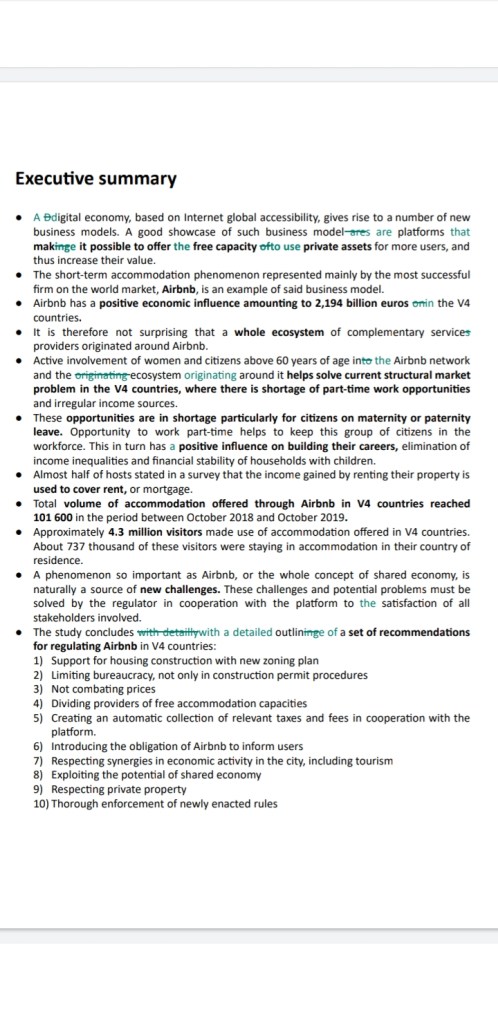
Rather than describe it I will let you read, if you so wish, their opening summary. I will talk more about the work I do instead. This type of work is somewhat difficult to get into. Supporting myself off any one labor is difficult and the amount of editing work that comes in varies. Work at schools and universities is much more lucrative. However, if you manage to find an offer TAKE IT. This kind of work is actually highly valued. More practice means more skill. More skill means more exposure. More exposure means more people offer you work. If you are freelance, spread your name. So how does editing work? There’s an easy answer which is you make it grammatically correct. The skill in this work comes out of the sound and not the content. There’s two places a word can be heard. The head and the ear. What is grasped is often based on the nature of the words. Shifting vocabulary that is grammatically correct to produce an audio effect without changing meaning is the true goal. Suggestions you find that will help the author lash his words to the mind. It is not my work so it is not my place to tell the story. My job is to see if what has been told needs be mold. I tell students of mine: The act of breaking rules is a necessary task, and that only fools follow the strictness of the facts of writing or speaking. Rules allow for repetition of lingual behavior but poets and wordsmiths are not bound by this when they deliver, however editors are. Especially if it’s for professionals.
When editing, the smaller the changes the better. You can see in the last picture places I made corrections. A task as simple as adding an “a” or shifting a word to just after the next. Sometimes small changes can have great impact. Don’t try to add yourself. If you do ask first and offer suggestion. Everyone has their own style but editors should be respectful in their duty. This is not mine, it is another’s. Let it stay that way.
 Short stories, poetry, writing, and art